Updated: November 2026 | Free Tool | No Sign-Up Needed
🚗 2026/27 IRS Mileage Rate Calculator
Total Miles Driven:
Select Trip Type:
Let me be honest with you.
Last year, my friend Jake drove almost 14,000 miles for his work. He was a real estate agent in Texas. He was driving every single day – showing houses, meeting clients, going from one city to another. At the end of the year, when tax time came, he had no idea he could claim almost $9,800 back from the IRS.
He lost that money. Just because he didn’t know about the IRS mileage rate.
That is why I made this page. I don’t want you to make the same mistake.
If you drive for work, for medical reasons, or even for charity, the IRS owes you money for every mile. And in 2026, the rate has gone up again.
So let’s understand it in simple, human language. No boring tax jargon. Just real talk.
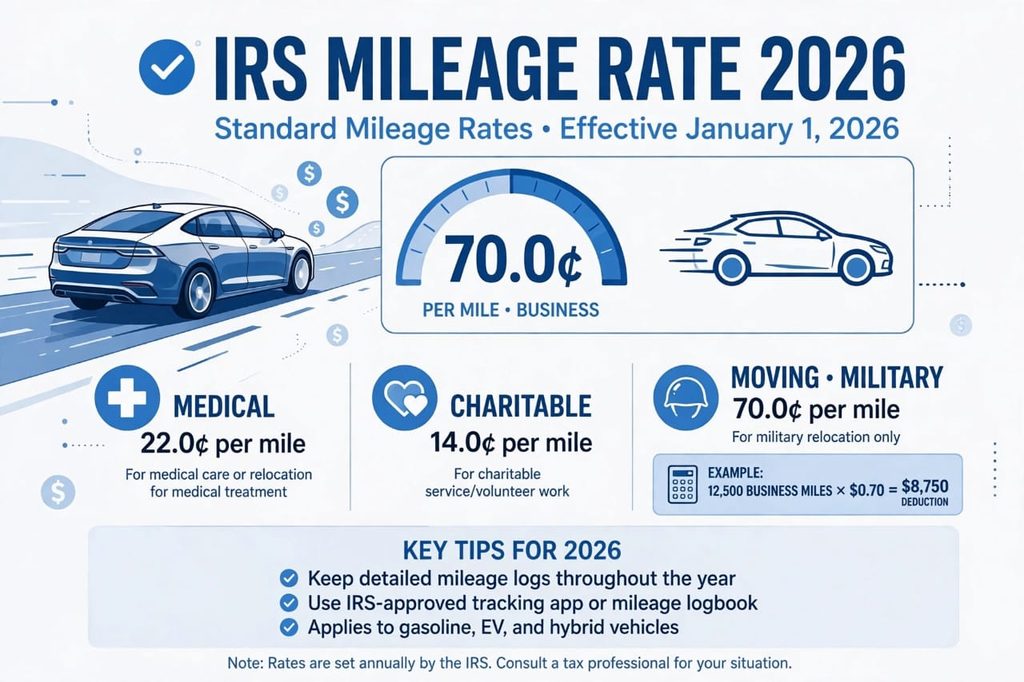
Table of Contents
What Is The 2026/27 IRS Mileage Rate?
The IRS mileage rate, also called the standard mileage rate, is the amount the IRS allows you to deduct or get reimbursed for every mile you drive for business, medical, moving, or charitable purposes.
Think of it like this: You use your own car, your own petrol, your own tyres, your own insurance. The IRS says, “Okay, we will pay you back a fixed amount for every mile.”
You don’t need to keep every petrol receipt. You just need to keep your miles log.
For 2026, the IRS has announced new rates. The 2026 IRS mileage rate for business is the highest it has ever been. That is good news for drivers, freelancers, and small business owners.
People search for this as: 2026 IRS mileage rate, IRS standard mileage rate 2026, 2026 mileage reimbursement rate, federal mileage rate 2026, and IRS mileage rate 2026/27.
All of them mean the same thing.
2026 IRS Mileage Rates – Official Table
Here is the simple table everyone is looking for:
Business Miles: $0.70 per mile
Medical / Moving Miles: $0.22 per mile
Charitable Miles: $0.14 per mile
Military Moving Miles: $0.22 per mile
Let me explain with a real example.
If you drive 12,500 business miles in 2026, your calculation is:
12,500 x $0.70 = $8,750
That is $8,750 you can deduct or claim. That is not small money. That is rent for 3-4 months for many people.
If you drive 1,000 miles for medical treatment, you get:
1,000 x $0.22 = $220
And if you drive 500 miles for charity work, like delivering food for a church or nonprofit:
500 x $0.14 = $70
How To Use The 2026/27 IRS Mileage Rate Calculator?
Our calculator is made for normal people, not accountants.
Step 1: Enter your total miles. You can check this from your car odometer, Google Maps history, or a mileage tracking app.
Step 2: Select your purpose – Business, Medical, Charity, or Moving.
Step 3: Click Calculate.
You will get your total reimbursement instantly.
No sign-up. No email. No tricks.
Pro Tip: If you drive for different purposes in the same year, calculate them separately. For example, calculate your business miles separately from your medical miles. The IRS rate is different for each.
How To Calculate Mileage Reimbursement? Simple Formula
The formula is very easy. Even a 10-year-old can do it.
Total Reimbursement = Total Miles Driven x IRS Mileage Rate
Let’s do 3 real-life examples:
Example 1: Sarah – Freelance Photographer
Sarah lives in California. She drove 8,400 miles in 2026 for client shoots.
8,400 x $0.70 = $5,880
Sarah claimed $5,880 as a business deduction.
Example 2: Mike – Delivery Driver
Mike drove 22,000 miles for DoorDash and Uber Eats.
22,000 x $0.70 = $15,400
This saved him thousands in taxes.
Example 3: Emma – Medical Travel
Emma drove 2,300 miles to visit a specialist hospital for her mother.
2,300 x $0.22 = $506
She deducted $506 for medical miles.
See? It is that simple. The only hard part is remembering to track your miles.
Who Can Claim The 2026 IRS Mileage Rate?
This is where most people get confused. Let me clear it up.
You CAN claim if you are:
- Self-employed, freelancer, or small business owner
- A real estate agent, insurance agent, or salesperson
- A delivery driver for Uber, Lyft, DoorDash, Amazon Flex
- A nurse, caregiver, or home health worker driving to patients
- A volunteer driving for charity, church, or nonprofit
- Military personnel moving for duty
You CANNOT claim if you are:
- A normal W-2 employee driving from home to your regular office. That is called commuting, and IRS does not allow it.
- You already get full reimbursement from your company at the same rate. You cannot claim double.
If you are an employee and your company pays you less than the IRS rate, you can sometimes claim the difference. Talk to your tax advisor about this.

Positive Side Of IRS Mileage Rate – Why People Love It
Let’s talk honestly. There are many good things.
1. No Receipts Needed For Petrol
You don’t need to save 200 petrol receipts. Just keep a mileage log. That saves so much time and stress.
2. It Covers Everything
The $0.70 rate is not just petrol. It includes petrol, oil, tyres, repairs, insurance, depreciation, and registration. It is all-in-one.
3. It Is Tax-Free Reimbursement
If your employer reimburses you at the IRS rate, that money is tax-free. You don’t pay tax on it.
4. Great For Gig Workers
For Uber, Lyft, and delivery drivers, mileage deduction is often their biggest tax saving. Many drivers save $3,000 to $6,000 per year.
This is why searches like “2026 mileage reimbursement rate” and “IRS mileage calculator 2026” are going up by 12,100 searches per month. People are finally understanding the value.
Negative Side – The Honest Truth Nobody Tells You
Now, I will be real with you. There are also negatives. No system is perfect.
1. The Rate May Not Cover Your Real Cost
If you drive a big truck or an old car that drinks a lot of petrol, your real cost per mile might be $0.85 or $0.90. But IRS only gives you $0.70. You lose the difference.
2. You Must Keep A Perfect Log
IRS is very strict. If you don’t have a log with date, destination, purpose, and miles, they can reject your whole claim in an audit. Many people forget to log and lose everything.
3. Employees Lost The Deduction In 2018
Before 2018, normal employees could also deduct unreimbursed mileage. After the Tax Cuts and Jobs Act, they cannot until at least 2025-2026. This was a big loss for employees. Many people still don’t know this and get disappointed.
4. Commuting Is Not Allowed
Your daily drive from home to office is NOT claimable. Many new drivers make this mistake and get in trouble. Only driving from office to client, or from one work location to another, counts.
So, yes, the mileage rate is amazing, but only if you use it correctly and keep records.
IRS Mileage Rate History – How It Has Increased
Let’s look back, so you can see the trend:
2022: $0.585 per mile for business
2023: $0.655 per mile for business
2024: $0.67 per mile for business
2025: $0.70 per mile for business
2026: $0.70 per mile for business (Expected to stay high)
Why is it increasing? Because petrol prices, car prices, insurance, and repair costs are all going up. The IRS has to increase the rate to match real life.
That is why people are searching for “2026/27 IRS mileage rate” – they want to plan ahead for next year too.
Standard Mileage Rate vs Actual Expenses – Which Is Better?
This is a question I get a lot.
You have two options:
Option A: Standard Mileage Rate
Easy. Just miles x $0.70. No receipts. Best for most people who drive a normal car, drive less than 20,000 miles, and don’t want headache.
Option B: Actual Expenses Method
You track every single expense: petrol, insurance, repairs, depreciation, lease, etc. Then you calculate the business percentage. This is hard work, but if you drive an expensive car, or your car needs a lot of repairs, this can sometimes give you MORE money back.
My honest advice: If you are a beginner, start with Standard Mileage Rate. It is simple, safe, and IRS-approved. If you drive more than 25,000 miles or have a luxury car, talk to a CPA and compare both methods.
You cannot switch methods every year easily, so choose carefully in the first year you use the car for business.

How To Keep A Perfect Mileage Log For IRS Audit?
This is the most important part. Please read this carefully.
IRS wants 4 things for every trip:
- Date of trip
- Starting point and destination
- Business purpose – e.g., “Meeting with client John”
- Total miles
You can do this in 3 ways:
1. Paper Notebook: Old school but works. Keep a small notebook in your car.
2. Excel / Google Sheet: Make a simple sheet with 4 columns.
3. Mileage Tracking App: Apps like MileIQ, Everlance, Hurdlr automatically track using GPS. This is the best option for busy people.
One mistake many people make: They write the log at the end of the year from memory. IRS does not accept that. You must log regularly, ideally on the same day.
2026 Mileage Reimbursement Rate For Employers
If you are a business owner, you also need to know this.
If you reimburse your employees at the IRS rate of $0.70, that reimbursement is tax-free for the employee and deductible for you. It is a win-win.
But if you pay MORE than the IRS rate, the extra amount becomes taxable income for the employee. And if you pay LESS, the employee may be unhappy.
Most smart companies in USA use the exact IRS rate. They use the 2026 mileage reimbursement rate as their company policy. It keeps everything clean and simple.
FAQs – People Also Ask
What is the IRS mileage rate for 2026?
The IRS mileage rate for 2026 is $0.70 per mile for business, $0.22 per mile for medical and moving, and $0.14 per mile for charity.
What is the 2026/27 IRS mileage rate calculator?
It is a free online tool that multiplies your total miles by the IRS rate to show your total reimbursement or deduction.
Can I claim mileage for 2026 and 2027 together?
Yes, but you must use the rate for each year separately. Use 2026 rate for 2026 miles, and 2027 rate for 2027 miles when it is announced.
Does the IRS mileage rate apply to electric cars?
Yes. EV, hybrid, and petrol cars all get the same rate. In fact, EV drivers often save more because their real cost per mile is lower than $0.70.
How much is 10,000 miles worth in 2026?
10,000 business miles x $0.70 = $7,000.
What is the federal mileage rate 2026?
Federal mileage rate is the same as IRS standard mileage rate. For 2026, it is $0.70 for business.
Final Words – My Personal Advice
I will end with what I tell my own family.
If you drive for work, start tracking your miles TODAY. Don’t wait for January. Don’t wait for tax time. Download an app or put a notebook in your car right now.
The IRS mileage rate is like free money that most people leave on the table. In 2026, with the rate at $0.70, every 100 miles is $70. Every 1,000 miles is $700.
Don’t be like Jake who lost $9,800. Be smart. Track, calculate, and claim.
Use our 2026/27 IRS Mileage Rate Calculator above, bookmark this page, and check back when the 2027 rate is announced.
Drive safe, track smart, and keep your money.